

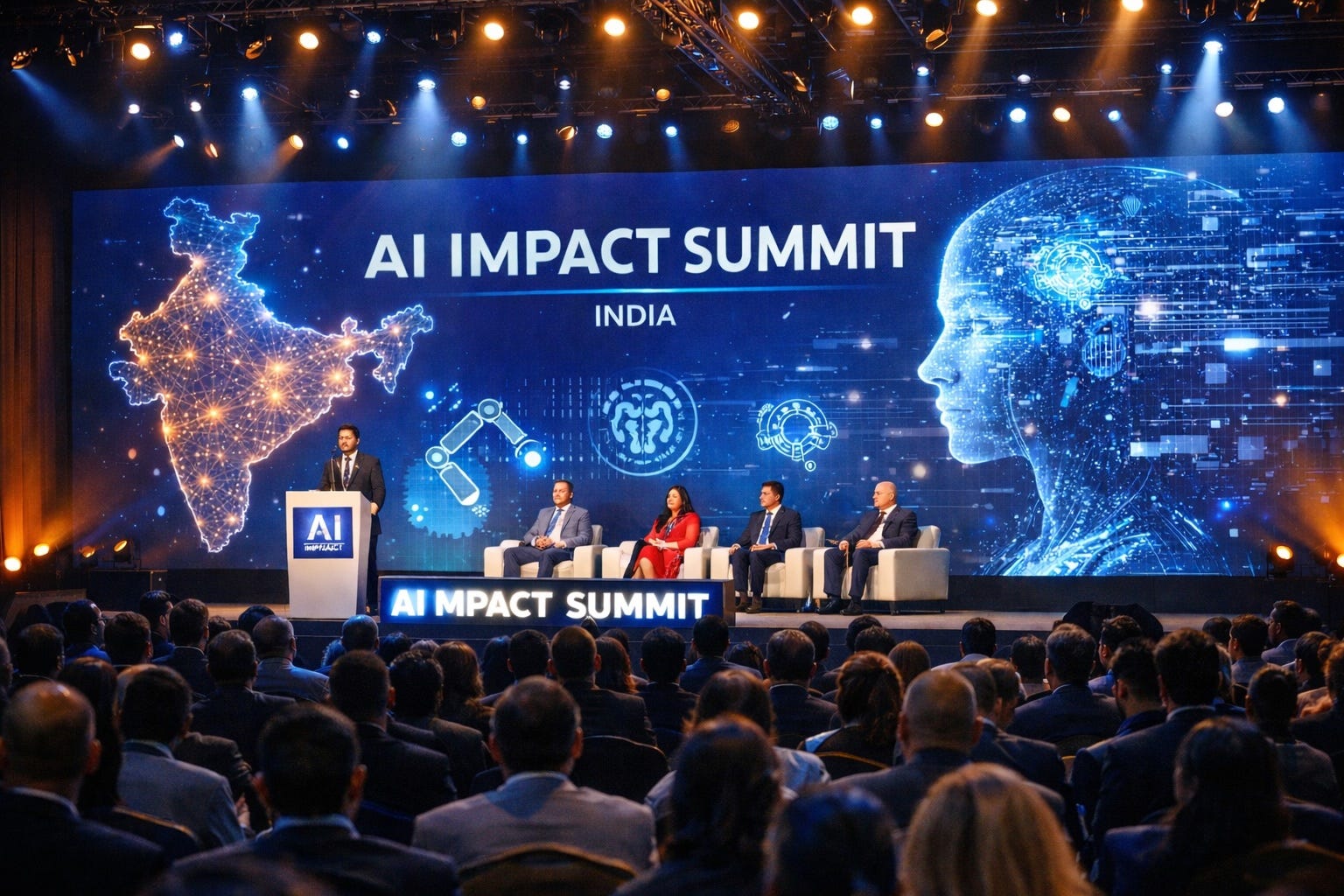
On February 16, 2026, India hosted the first-ever global AI summit in the Global South. Over 100 countries sent delegations. More than 20 heads of state arrived. Tech CEOs from Google, OpenAI, Anthropic, and DeepMind gathered at Bharat Mandapam in New Delhi. The stated mission: translate AI discussions into development outcomes. The reality: a masterclass in the gap between aspiration and execution.
I’ve spent two decades designing systems that serve hundreds of thousands of users across distributed geographies. I’ve seen frameworks persist long after they’ve stopped serving their purpose—a pattern I explore throughout my book Unfinished. The India AI Impact Summit wasn’t just another conference. It was a live demonstration of what happens when inherited thinking about how summits “should” work collides with the complexity of actually making them work.
The Three Sutras: People, Planet, Progress
The summit anchored itself around three foundational pillars—Sutras, meaning guiding principles in Sanskrit. Each was meant to define how AI could be harnessed for collective benefit:
People: AI must serve humanity in all its diversity, preserving dignity and ensuring inclusion.
Planet: AI innovation must align with environmental stewardship and sustainability.
Progress: AI’s benefits must be equitably shared, advancing global development.
These weren’t empty platitudes. They translated into seven thematic working groups covering AI for economic growth, democratizing resources, social inclusion, safety and trust, human capital development, scientific advancement, and resilience. India announced initiatives like training 500 PhD scholars and 5,000 postgraduates in AI research. The country’s AI-powered technology sector projected revenues of $280 billion for 2025. Nearly 89% of new startups launched in 2024 integrated AI into their products.
The architecture was sound. The intentions were genuine. But architecture means nothing if the execution infrastructure can’t support it.
When VIP Culture Meets Scale
Here’s what actually happened: New Delhi’s already notorious traffic became completely gridlocked. Why? Because when dozens of heads of state and global CEOs need to move through a city simultaneously, police close roads entirely—a practice locals call “VIP movements.” Speakers missed their own sessions. Delegates spent hours stuck in traffic. Yoshua Bengio, one of AI’s “godfathers,” delivered his address via blurry video link from the Canadian embassy because he couldn’t physically reach the venue.
On day one, exhibitors were thrown out of the venue with no warning at midday to accommodate Prime Minister Modi’s visit. Gates closed until 6 PM. One founder had his display tech stolen during the chaos. People reported two-hour entry queues after three-hour drives. The overcrowded rooms, ever-changing entry policies, and poor communication infrastructure created what attendees described as a “third-class citizen” experience for anyone not classified as a VIP.
This is what I call the implementation paradox: the gap between what we design on paper and what actually works when humans encounter it at scale.
The Robot That Wasn’t
Perhaps the most revealing moment came on February 18. Galgotias University showcased a robot dog at their exhibition pavilion, presenting it as indigenous innovation. Social media users immediately identified it as the Unitree Go2—a commercially available product from Chinese company Unitree Robotics. The university apologized, claiming their representative was “ill-informed.” They were directed to vacate their stall.
The incident exposed something deeper than misrepresentation. It revealed the pressure to demonstrate innovation credentials on a global stage—and what happens when that pressure meets inadequate verification systems. In my work designing AI-augmented systems for enterprise environments, I’ve learned that the most critical failures aren’t technical. They’re process failures that allow unchecked claims to reach production.
What Actually Shipped
Despite the operational chaos, the summit produced tangible outcomes. Eighty-eight countries and international organizations signed onto a diplomatic declaration committing to inclusive AI development. India set a Guinness World Record with 250,946 pledges for an AI responsibility campaign in 24 hours—far exceeding the initial 5,000-pledge target.
Sarvam AI, an Indian laboratory, launched new language models including 30-billion and 105-billion parameter models using mixture-of-experts architecture. The Research Symposium on AI and its Impact brought together leading researchers to discuss sovereign AI infrastructure, global adoption challenges, and policy priorities. These weren’t performative announcements. They represented real progress in a country positioning itself as a key platform for shaping the global AI agenda.
The India AI Impact Expo featured over 300 exhibitors from 30 countries across more than 10 thematic pavilions. Applications spanned healthcare, agriculture, education, and sustainable industry. The event ran six days instead of five due to overwhelming public response.
The Unspoken Reality
Here’s what the official narratives won’t tell you: Amnesty International pointed out that while India was lauded for technological progress, human rights concerns around AI deployment in the country—including facial recognition and public sector automation that excludes marginalized communities—were “papered over.” The summit’s push toward sovereignty, innovation, and democratization, they argued, feeds a global trend of turning AI into a power accumulation race rather than collective action for rights protections.
This tension isn’t unique to India. It’s the fundamental challenge of AI governance: How do you balance rapid development with genuine safeguards? How do you ensure technology serves people when the very definition of “serving people” is contested terrain?
What This Tells Us About AI’s Future
The India AI Impact Summit revealed something more important than its documented achievements or failures. It showed us that the future of AI won’t be determined primarily by technical capabilities. It will be determined by our ability to translate high-level principles into working systems that serve real people in real contexts.
The summit’s title shifted from “AI Safety” (Bletchley Park, 2023) to “AI Action” (Paris, 2025) to “AI Impact” (New Delhi, 2026). According to legal analysts at Crowell & Moring, these changing titles reflect a broader shift away from governance toward practical implementation and measurable outcomes.
But implementation requires more than good intentions and impressive pavilions. It requires:
Infrastructure that matches ambition. You can’t host 100+ country delegations and dozens of VIPs without transportation systems that actually move people to where they need to be.
Verification systems that work. You can’t celebrate indigenous innovation without processes that catch misrepresentation before it reaches the exhibition floor.
Cultural awareness at scale. You can’t design for “People, Planet, Progress” while maintaining VIP cultures that leave most participants feeling like obstacles to be managed.
In my work architecting digital experiences that serve hundreds of thousands of users, I’ve learned that the hardest problems aren’t about technology. They’re about the inherited assumptions we carry about how things “should” work—even when those assumptions actively prevent things from working.
The Real Test
India’s next challenge isn’t launching more AI models or hosting more summits. It’s demonstrating that the principles articulated in those three Sutras can actually shape how AI gets developed and deployed—not just in policy documents, but in systems that real people use every day.
The summit succeeded in positioning India as a serious player in global AI conversations. It created space for Global South perspectives that are often sidelined in technology discussions dominated by American and Chinese companies. It generated commitments, showcased innovations, and set records.
But it also reminded us that designing for impact requires more than ambitious frameworks. It requires the unglamorous work of making systems actually function when they encounter scale, complexity, and the messy reality of human needs.
The Switzerland AI Summit scheduled for 2027 will be watching. The question isn’t whether they can avoid traffic jams and verification failures. The question is whether these gatherings can evolve beyond diplomatic theater toward something that genuinely advances AI in service of humanity.
Because right now, we’re still figuring out how to make the summit itself work—let alone the technology it’s meant to govern.
About the Author
I work at the intersection of design, technology, and human experience—crafting intelligent systems that amplify human capability rather than replace it. As a Digital Experience Design Architect, my practice is grounded in a belief that the most meaningful innovations emerge not from technology alone, but from deeply understanding how people think, work, and create.
My approach combines rigorous methodology with creative vision. I question assumptions, challenge conventional wisdom, and seek patterns that others might miss. Whether exploring user research methodologies, designing enterprise systems, architecting digital experiences, or examining broader societal challenges, I maintain a critical lens that asks not just “what works” but “why it works” and “for whom does it work best.”
Each article I write reflects this philosophy: technology should expand our creative horizons, design should serve genuine human needs, and innovation should be tempered with wisdom about its implications.
For more on AI implementation, enterprise design, and questioning established thinking:
Subscribe to User First Insight
Connect on LinkedIn
Visit stayunfinished.com