

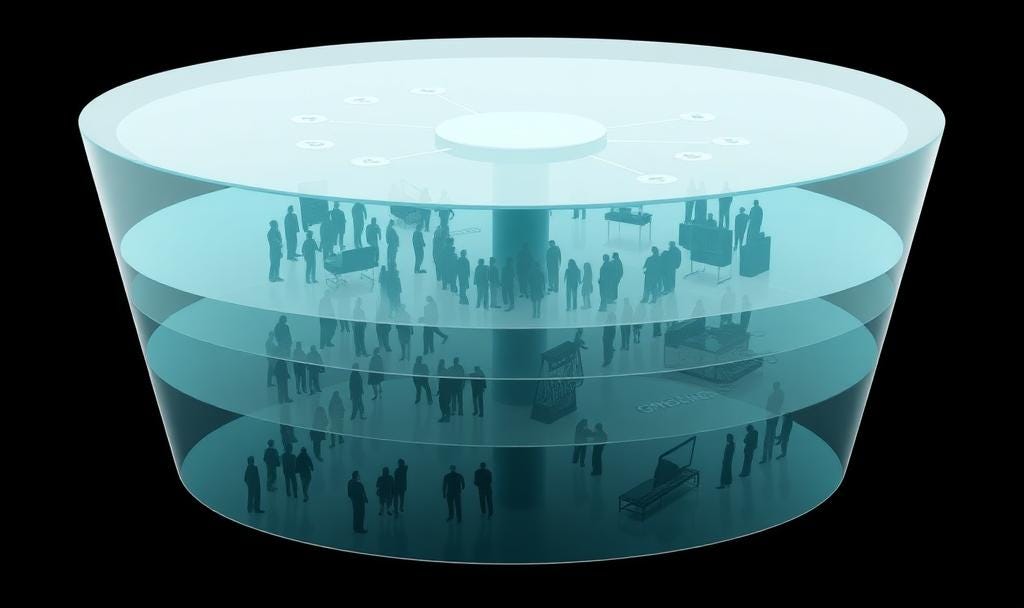
The conversation about UX team structure often presents false choices: centralized versus decentralized, embedded versus independent, autonomy versus alignment. We debate reporting lines, draw org charts, and search for the perfect model as if structure alone determines success.
But here’s what five years of building UX practice at enterprise scale has taught me: the model matters far less than your willingness to keep evolving it.
I work in an organization serving over 200,000 users across a geographically distributed operation. We’re responsible for digital and AI initiatives that span the entire enterprise—from core products like our intranet to design systems, governance frameworks, and consulting on complex projects throughout the organization. The scale alone makes traditional centralized models impossible. Yet complete decentralization would sacrifice the consistency and cohesion that enterprise experiences demand.
So we’ve built something different. Not because we followed a framework, but because we kept asking: What actually works here? For these people? In this context?
The Reality of Distributed Governance
Our structure is fundamentally decentralized—UX professionals are distributed across departments and geographies, embedded in product teams throughout the organization. But we maintain a central governance function that does three critical things:
We train practitioners across departments to serve as UX representatives within their teams. These aren’t junior designers learning basics; they’re professionals we develop to maintain standards while adapting to local needs.
We consult on complexity. When product teams face genuinely difficult challenges—architectural decisions, cross-platform experiences, novel interaction patterns—we engage directly. Not as gatekeepers, but as specialized expertise activated when it matters most.
We own the connective tissue. The intranet experience. How services integrate into larger ecosystems. The design system that ensures consistency without constraining creativity. Governance documents that provide direction without dictation.
This isn’t a model I found in an article or extracted from a case study. It’s what emerged from constantly asking: Is this still working? Where are the gaps? What needs to change?
What Traditional Models Miss: The Gradient Between Structure and Practice
Most UX organizational frameworks assume a level of control that enterprises can’t actually exercise. They optimize for reporting clarity, role definition, and clean boundaries. But they miss something crucial: at scale, structure becomes less important than systems of influence.
Consider the typical managed-integration approach, where UX reports to UX leadership while embedding in product teams. It’s elegant in theory. In practice, with hundreds of practitioners across vast geographies supporting dozens of initiatives simultaneously? The reporting line becomes an abstraction. What matters is:
Knowledge transfer systems that help distributed teams learn from each other
Governance that guides without constraining local adaptation
Core products that demonstrate standards rather than mandate them
Strategic consulting capacity that can parachute in when needed
We don’t achieve consistency through command and control. We achieve it through deliberate cultivation of practice, supported by infrastructure that makes good work easier than inconsistent work.
The Tooling Philosophy: Permanence is Fiction
Here’s where enterprise UX often calculates incorrectly: we invest enormous energy selecting “the right tools,” as if choosing correctly means we’re done choosing.
Our approach is different. We treat tools as temporary scaffolding for current thinking.
Today—literally as of October 21, 2025—we’re heavily using Make for design workflows, experimenting with vibe coding through Windsurf, Cursor, and Lovable, and employing AI extensively for research synthesis, heuristic analysis, and workflow automation. Six months from now? The list will look different.
This isn’t chaos. It’s acknowledging that in my book Unfinished, I argue that design practice must embrace constant transformation rather than resist it. The same applies to how we structure teams and select tools. We’re not building permanent architecture; we’re building adaptive capacity.
The moment you stop experimenting—the moment you declare “this is how we do things here” and close the door on evolution—you’ve begun calcifying.
When Decentralization Creates New Problems
I won’t pretend our approach is perfect. Decentralization at this scale creates real challenges:
Visibility becomes difficult. With practitioners embedded across the organization, understanding what’s actually happening—where the struggles are, where the innovations emerge—requires deliberate systems, not just good intentions.
Quality becomes variable. When you can’t directly manage every practitioner’s daily work, you rely on training, governance, and culture to maintain standards. Sometimes that’s insufficient.
Resource allocation becomes complex. You can’t simply assign designers to teams when those designers already belong to other organizational units. Influence must substitute for authority.
Consistency requires active maintenance. Our design system isn’t just documentation—it’s an ongoing conversation about what consistency means when contexts vary wildly.
We address these through regular training cycles, active consulting engagement on complex projects, and owning the experiences that set organizational standards. But I’m not claiming we’ve “solved” decentralization. We’re constantly adjusting our approach as we discover what works and what doesn’t.
The Cultural Dimension: What Works Depends on Context
One aspect rarely discussed in Western UX literature: cultural context fundamentally shapes what “good” structure looks like.
Working in the Middle East, serving a workforce that spans cultures, languages, and contexts, we learned early that certain assumptions don’t travel. Visual language that seems universal isn’t. Interaction patterns that feel intuitive in one context confuse in another. Even the concept of “user-centered design” requires translation—not just linguistically, but philosophically.
Our governance approach reflects this. We maintain professional, clear visual language that works across contexts. We avoid assuming shared cultural references. We test across user segments that Western organizations might treat as homogeneous.
This isn’t about being “sensitive” or “inclusive” in some abstract sense. It’s recognition that enterprise UX at global scale demands humility about your assumptions. The best model is the one that works for your users, not the one that worked for someone else’s users.
The Framework We’re Building: Incremental Evolution Over Grand Redesign
Rather than perfect our current structure, we’re developing a framework for continuous structural evolution. The core principles:
1. Structure serves strategy, not vice versa. When organizational priorities shift, our structure should shift with them. Rigidity is failure.
2. Governance guides through demonstration, not mandate. Our core products show what good looks like. Our design system makes consistency easy. Our consulting engagements spread practices through doing, not documenting.
3. Decentralization requires strong connective tissue. You can’t just distribute practitioners and hope for coherence. You need shared systems, regular forums, and deliberate knowledge sharing.
4. Metrics matter, but not the ones you think. We track impact through adoption of standards, reduction in redundant work, and practitioner capability growth—not hours logged or tickets closed. (Note: specific numbers remain confidential, but the trajectory shows consistent improvement in all three areas.)
5. Tools are disposable; capability is permanent. Invest in people’s ability to learn and adapt, not in perfect tool selection.
This framework isn’t finished. It won’t ever be finished. That’s the point.
What Most UX Leaders Get Wrong
Here’s my contrarian take after years of building UX practice at enterprise scale: Most UX leaders optimize for the wrong thing.
They optimize for structural clarity when they should optimize for adaptive capacity. They perfect reporting lines when they should perfect learning systems. They seek the right model when they should build the capability to keep evolving models.
The conventional wisdom provides valuable direction—understanding centralized versus decentralized tradeoffs, recognizing the challenges of matrix reporting, appreciating the value of embedded practitioners. But direction isn’t dictation. The path you take depends entirely on your context, your culture, your constraints, and your users.
An organization of 500 needs different structure than one of 50,000. A product company has different needs than an enterprise with internal users. A culture that values hierarchy requires different approaches than one that prizes autonomy.
The wisdom isn’t in choosing the right model. The wisdom is in building your capacity to keep questioning whether your current model still serves its purpose.
The Invitation: Share What Actually Works
I’m developing this framework further because I suspect many large organizations face similar challenges—too big for pure centralization, too complex for simple decentralization, too dynamic for static structures.
I want to hear from practitioners and leaders building UX at scale:
What’s your organizational size, and what structure have you adopted?
Where does your model succeed? Where does it struggle?
What have you learned that contradicts conventional wisdom?
How do you maintain consistency while enabling local adaptation?
This isn’t academic curiosity. It’s recognition that the best insights emerge from collective intelligence, not individual genius. The frameworks that matter most are built collaboratively, tested in real contexts, and evolved through shared learning.
Closing: The Only Constant is Evolution
In Unfinished, I argue that design must embrace constant transformation—that the systems we build exist in a state of permanent becoming rather than completed being. Our UX practice reflects this philosophy directly. We don’t have a perfect structure. We have a structure that works reasonably well right now, with systems in place to help us recognize when it stops working and evolve accordingly.
This is the actual work of enterprise UX leadership: not finding the right answer, but building the organizational capacity to keep asking better questions. Not implementing the perfect model, but creating conditions where people can experiment, learn, fail safely, and improve continuously.
The tools will keep changing. The challenges will keep evolving. But the mission remains constant: creating experiences that genuinely serve human needs, at whatever scale necessary, through whatever structure makes that possible.
Technology should expand our creative horizons. Structure should enable rather than constrain. And wisdom comes not from following the book, but from understanding when to write your own.
Ready to explore further? Subscribe to User First Insight for perspectives on design, technology, and human experience in enterprise contexts. For broader explorations of how we navigate complex systems and societal challenges, follow Black & White Perspective. And if these ideas resonate, Unfinished: Notes on Designing Experience in a World That Never Stops Changing offers deeper exploration of designing for constant transformation.
Connect with me on LinkedIn for professional conversations, follow my writing on Medium for additional insights, and visit haiderali.co and stayunfinished.com to continue the conversation.
This isn’t just content—it’s an invitation to question, evolve, and reimagine what becomes possible when we approach both structure and practice with critical thinking and adaptive action.